Why Genuine Students Still Get PR Pathways After 2026 Visa Changes
The landscape of Australian international education and skilled migration has experienced significant evolution over recent years. Headline policy adjustments, refined financial thresholds, and tighter compliance measures surrounding the Subclass 500 Student visa have left many prospective international students wondering whether studying in Australia remains a viable step toward Permanent Residency (PR).While Australia has tightened visa entry requirements to eliminate non-genuine study routes, genuine students who align their education with long-term skill needs continue to enjoy structured, reliable pathways to permanent residency.Understanding how to navigate these reforms—starting with a strong Genuine Student (GS) profile and progressing through the Temporary Graduate visa (Subclass 485)—is the key to unlocking your post-study career and migration goals.The Shift in 2026: Tighter Gatekeeping, Unchanged Skilled Migration Goals
To understand why PR options remain robust, it is helpful to look at the motivation behind recent Department of Home Affairs updates.
The Australian Government’s migration strategy focuses on integrity, ensuring that education providers deliver high-quality outcomes and that visa applicants are authentic students. Key updates implemented in recent visa frameworks include:
The Genuine Student (GS) Requirement: Replacing the former Genuine Temporary Entrant (GTE) framework, the GS requirement evaluates an applicant’s academic trajectory, career logic, personal background, and economic ties.
Increased Financial Proof Thresholds: Applicants must demonstrate higher verifiable living cost savings and tuition capacity to ensure financial stability during their studies.
Subclass 485 Streamlining: Age limits and post-study work stream stay durations were recalibrated to prioritize skilled graduates aligned with economic priorities.
Strict Onshore Visa Switching Restrictions: Policies limit "visa-hopping" from visitor or graduate visas back into lower-level student visas, ensuring students follow intentional academic pathways.
Why This is Good News for Authentic Applicants
While these changes create higher entry hurdles, they also create a less congested, more favorable environment for authentic students. Australia’s permanent migration ceiling remains substantial, with around 185,000 places allocated per program year, the majority dedicated to the Skilled Migration stream.
By raising the entry bar for temporary admissions, the government ensures that genuine students who complete quality Australian qualifications face less noise and better positioning when competing for points-tested PR invitations and state nominations.
Step 1: Winning at the Front Door — The Genuine Student (GS) Requirement
Your path to permanent residency does not begin when you graduate; it begins when you lodge your initial Student visa (Subclass 500) application. The Genuine Student framework requires targeted, well-evidenced answers to specific assessment questions:
Current Circumstances & Background: Your employment, family, community, and economic context.
Rationale for Course & Institution: Why this specific qualification and Australian provider fit your career path better than options in your home country.
Future Career & Economic Benefits: How completing this study directly translates to career progression, realistic employment outcomes, and enhanced earning potential.
Academic or Employment Gaps: Clear, documented explanations for any past breaks in education or work.
| Academic Intent | Clear progression and rationale |
|---|---|
| Financial Access | Verifiable, unencumbered funds |
| Career Value | Logical return on investment |
| Important Distinction |
|---|
| Demonstrating a primary intent to study under the GS test does not forbid you from holding long-term aspirations for Australian migration. However, your immediate application must prove that your educational choice is authentic, financially viable, and logically connected to your personal background. |
Step 2: The Bridge to PR — The Subclass 485 Temporary Graduate Visa
Once you complete a CRICOS-registered course of study in Australia, the Temporary Graduate visa (Subclass 485) serves as your critical professional bridge.
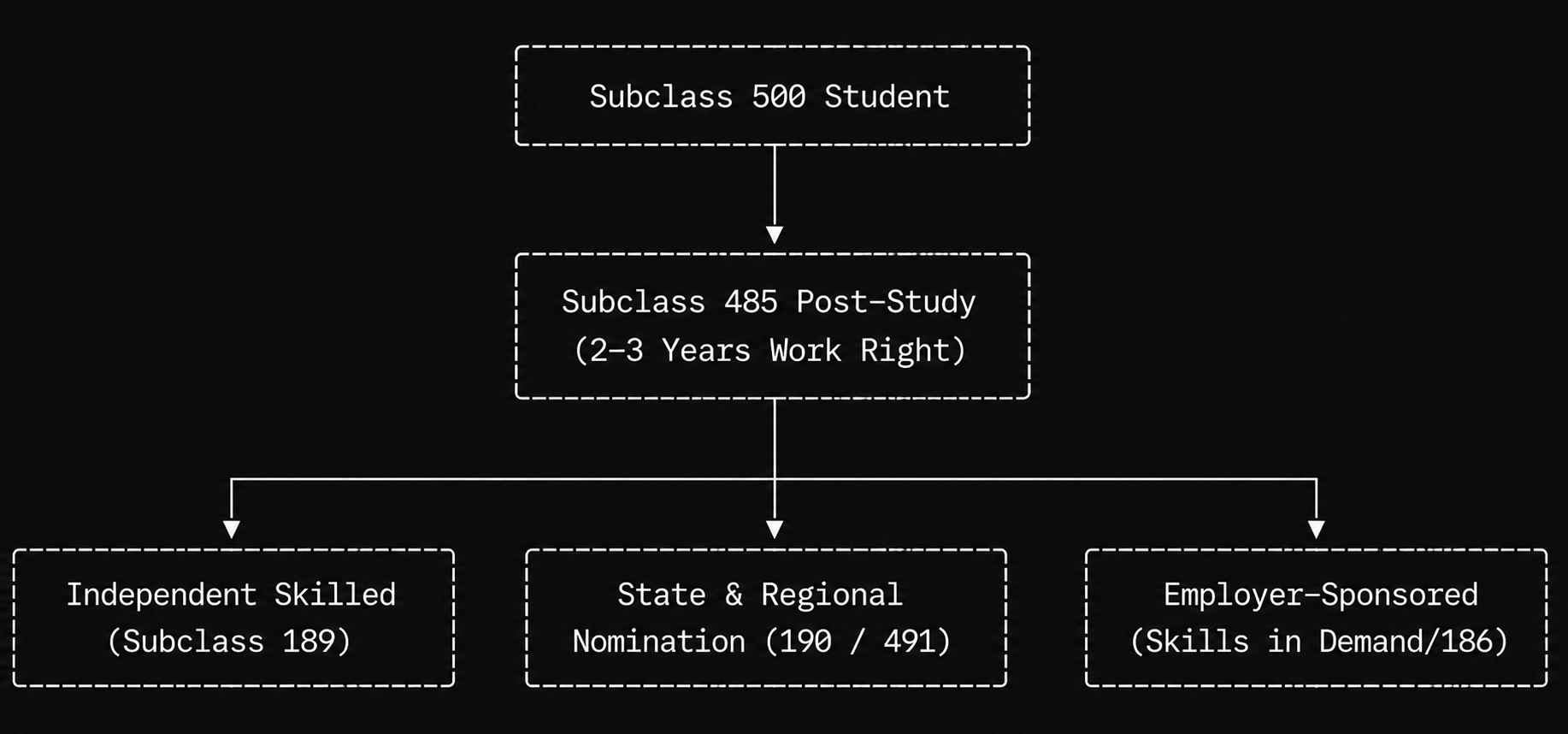
The Subclass 485 visa grants unrestricted work rights, allowing international graduates to:
Gain vital Australian post-qualification work experience.
Complete full Skills Assessments through relevant assessing authorities (e.g., Engineers Australia, ACS, CPA/CAANZ, TRA, ANMAC).
Achieve higher English language test scores (IELTS / PTE) to maximize skilled points.
Build professional networks that lead to direct employer sponsorship.
| Qualification Level | Standard Post-Study Stay Period | Key Advantage for PR |
|---|---|---|
| Bachelor Degree (Inc. Honours) | 2 Years | Time to secure skilled employment and pass skills assessment. |
| Master Degree (Coursework/Extended) | 2 Years | Advanced skills points and higher starting salaries in high-demand roles. |
| Master Degree (Research) | 2 Years | Eligible up to higher age limits; ideal for specialized technical pathways. |
| Doctoral Degree (PhD) | 3 Years | Maximum flexibility and priority invitation considerations. |
Primary Permanent Residency Pathways for International Graduates
Once you hold a Subclass 485 visa or complete eligible studies, multiple statutory pathways lead to Australian Permanent Residency.
State and Territory Nomination (Subclass 190)
State nomination is one of the most effective pathways for graduates. Individual Australian states and territories (such as NSW, Victoria, Queensland, WA, SA, Tasmania, ACT, and NT) publish occupation lists targeted at local labor shortages. Many states offer dedicated "Graduate Streams" that give priority nomination to international students who studied locally.
Regional Skilled Visas (Subclass 491 & 191)
Studying or moving to designated regional areas unlocks significant advantages:
Extra Points: Regional study awards bonus points toward your General Skilled Migration score.
Subclass 491 Visa: A 5-year provisional visa nominated by a state or regional body, offering 15 points boost on your EOI.
Pathway to PR (Subclass 191): After living and working in a regional area on a 491 visa for three years while meeting income/compliance requirements, you can transition directly into Permanent Residency.
Employer-Sponsored Pathways (Skills in Demand & Subclass 186)
With employer demand high across health, technology, engineering, education, and trades, many graduates leverage their 485 post-study work periods to secure an employer sponsor.
Temporary Skilled Sponsorship: Under the modern temporary skilled framework, graduates gain full-time experience with an approved employer.
Employer Nomination Scheme (Subclass 186): After completing the required years of skilled work with a nominating employer, applicants can secure direct permanent residency via the Temporary Residence Transition (TRT) stream.
Independent Skilled Migration (Subclass 189)
For top-tier applicants in priority occupations (e.g., healthcare, teaching, construction management), the points-tested Subclass 189 visa offers direct, non-sponsored Permanent Residency. High points totals—boosted by Australian qualifications, English proficiency, and local work experience—make graduates strong competitors in invitation rounds.
Financial Scrutiny: The #1 Reason Visas Get Rejected Before PR Starts
You cannot reach a PR pathway if your Student visa application is refused at the outset. In 2026, the Department of Home Affairs scrutinizes financial capacity with unmatched precision.
A significant proportion of student visa refusals stem from financial evidence inconsistencies rather than academic capability.
Red Flags That Trigger Refusals:
Unexplained Large Deposits: Sudden lump-sum transfers into bank accounts right before lodging without clear, documented source history.
Weak Relationship Proof for Sponsors: Using third-party financial sponsors without clear, verifiable evidence of family commitment or ongoing financial access.
Mismatched Tax & Income Documentation: Submitting tax returns, business registrations, or salary slips that contradict the stated account balances.
Failure to Account for Total Living Costs: Overlooking dependent costs, travel allowances, or upcoming tuition fees in overall calculations.
How to Protect Your Application: Audit Before You Lodge
Given the higher visa application charges and strict refusal consequences, getting your application right the first time is vital. Identifying risk factors before the Department of Home Affairs reviews your file can make the difference between a visa grant and a costly rejection.
Take Action: Get Your Free Audit
Before submitting your Australian Student Visa (Subclass 500) application, ensure your documents stand up to rigorous Department standards.
Take advantage of the Think Visa Genuine Student and Financial Evidence Audit.
WHAT YOUR CONFIDENTIAL THINK VISA AUDIT INCLUDES
Financial Evidence Consistency Check
Genuine Student (GS) Response & Narrative Evaluation
Documentation & Evidence Gap Identification
Personalised Strategy by Registered Migration Agents (RMA)
By ensuring your initial entry is backed by a rock-solid, compliant application, you safeguard your investment and set yourself on a clear, confident path toward post-study success and permanent residency in Australia.
Your Australian visa journey starts with one conversation.
Australia's visa landscape is complex and changes regularly. Rather than spending hours reading conflicting information online, speak directly with a registered migration agent who can give you a clear, honest picture of your options — within 15 minutes.
MARA-Registered Migration Agents
Regulated by the Office of the Migration Agents Registration Authority. Qualified, accountable, and legally authorised to advise you.
Fast Response During Business Hours
Our team typically calls back within 5 minutes of receiving your enquiry — no waiting days for a reply.
Completely Confidential
Your details are shared only with the migration agent handling your case. No third-party marketing, no obligation.
All Visa Pathways Covered
Skilled, employer-sponsored, partner, student, parent, business — we assess every practical route and tell you which is realistic for your situation.