Labour Day Insight: How Skilled Workers Can Position Themselves for State Nomination in 2026
Every year, Labour Day in Australia celebrates the contributions of workers who help build the country’s economy and communities. For skilled migrants already working or planning to work in Australia, this occasion is also a timely reminder of the opportunities available through Australia’s skilled migration program.
In 2026, competition for permanent residency remains strong. With only 20,350 places allocated across state nomination programs, skilled migrants must take a more strategic approach to securing an invitation.
For many applicants, state nomination pathways — particularly the Subclass 190 Skilled Nominated Visa and Subclass 491 Skilled Work Regional (Provisional) Visa — can significantly increase the chances of receiving a visa invitation.
Understanding how these pathways work — and how to position your profile effectively — can make the difference between waiting indefinitely and progressing toward permanent residency.
Understanding How State Nomination Works
Australia’s state nomination process begins with the SkillSelect platform, where skilled migrants submit an Expression of Interest (EOI).
Once submitted, individual Australian states and territories review EOIs based on their own migration priorities. These priorities often reflect local labour shortages, economic needs, and regional development goals.
Each state has its own eligibility criteria, which may include:
Occupations listed on state-specific skilled occupation lists
Minimum work experience requirements
Employment within the nominating state
Evidence of commitment to live and work in the region
When a state identifies a suitable candidate, it issues an invitation to apply for nomination. If the nomination is approved, applicants receive additional points in the migration points test:
5 points for the Subclass 190 Skilled Nominated Visa
15 points for the Subclass 491 Skilled Work Regional (Provisional) Visa
Once a visa invitation is issued, applicants have 60 days to submit a full visa application with supporting documents.
Different states use different selection mechanisms. For example:
South Australia often prioritises applicants with local employment or in-demand occupations.
Australian Capital Territory uses the Canberra Matrix, a ranking system based on employment, income, and residency factors.
Western Australia regularly conducts invitation rounds for eligible applicants.
Because these requirements frequently evolve, having a clear strategy is essential.
Key Factors States Evaluate
State governments assess several factors when determining which candidates to nominate.
Occupation Demand
Your occupation must appear on the state’s eligible skilled occupation list, often based on national lists such as the Medium and Long‑term Strategic Skills List.
States prioritise occupations experiencing labour shortages, particularly in sectors such as healthcare, engineering, education, and construction.
Relevant Work Experience
Work experience — especially within Australia — demonstrates your ability to contribute immediately to the local workforce.
Applicants who are already working in the nominating state often receive stronger consideration.
Regional Commitment
For regional visas such as the Subclass 491 Skilled Work Regional (Provisional) Visa, states want assurance that migrants genuinely intend to live and work in regional communities.
Evidence may include:
Employment within the state
Study completed in regional areas
Residency history
Statements of commitment to remain in the region
English Proficiency and Points Score
Applicants must meet the minimum points requirement of 65, including nomination points. However, due to competition, successful applicants often have significantly higher scores. Additional factors such as job offers, regional employment, or advanced English scores can further strengthen an application.
Points Optimisation Strategies
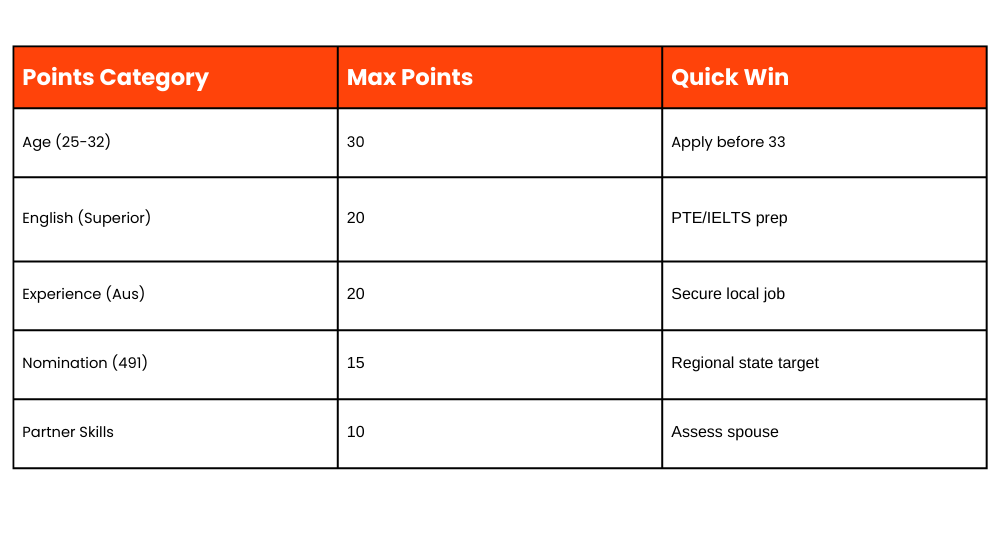
Maximize your base score through superior English (e.g., PTE 79+ for 20 points), NAATI credentials (5 points), and partner skills assessment (up to 10 points). Australian work experience adds 5-20 points per year, while state nomination itself provides 5 or 15 points to reach competitive totals like 95+.
Target subclass 491 for its 15-point boost if regional living suits you, and build Australian experience via bridging studies or Professional Year programs. States select high-scorers, so update your EOI frequently with new qualifications.
Critical Timing and Documentation
The Australian migration program operates on an annual cycle from 1 July to 30 June. During this period, each state receives a limited number of nomination places. Once these allocations are exhausted, further invitations may not be issued until the next program year.
To remain competitive, applicants should ensure that key documents are prepared early, including:
Valid passports
Skills assessments
English test results
Employment evidence (contracts, payslips, and superannuation records)
Detailed position descriptions
Educational qualifications
Skills assessments and English tests typically have validity periods, and delays in preparing documentation may cause applicants to miss invitation rounds.
Building a Winning Migration Action Plan (MAP)
Because state nomination requirements vary widely, successful applicants often develop a structured migration strategy before submitting their EOI.
A Migration Action Plan (MAP) may include:
Identifying the most suitable states for nomination
Mapping out a points optimisation strategy
Preparing key documentation in advance
Monitoring state invitation rounds and policy changes
Planning realistic timelines for visa eligibility
For example:
Tasmania may provide opportunities for graduates with local study experience.
Northern Territory often prioritises applicants committed to regional living.
By aligning your profile with state priorities, a structured migration plan can significantly improve your chances of receiving an invitation.
Labour Day Limited-Time Offer from Think Visa
This Labour Day, Think Visa is recognising the contribution of skilled workers who aspire to build their future in Australia. Our migration professionals specialise in strategic planning for state nomination pathways, helping skilled migrants navigate complex requirements and optimise their chances of success.
As part of our Labour Day 2026 campaign, we are offering:
A Migration Action Plan consultation for A$50 (usually A$99).
During this session, our team will:
Assess your eligibility for state nomination
Identify potential pathways through subclass 190 or 491
Provide a personalised migration strategy roadmap
With limited nomination places available each year, having a clear strategy early can make a significant difference. If you are planning your pathway to Australian permanent residency, this Labour Day may be the perfect time to start building your migration strategy.
Your Australian visa journey starts with one conversation.
Australia's visa landscape is complex and changes regularly. Rather than spending hours reading conflicting information online, speak directly with a registered migration agent who can give you a clear, honest picture of your options — within 15 minutes.
MARA-Registered Migration Agents
Regulated by the Office of the Migration Agents Registration Authority. Qualified, accountable, and legally authorised to advise you.
Fast Response During Business Hours
Our team typically calls back within 5 minutes of receiving your enquiry — no waiting days for a reply.
Completely Confidential
Your details are shared only with the migration agent handling your case. No third-party marketing, no obligation.
All Visa Pathways Covered
Skilled, employer-sponsored, partner, student, parent, business — we assess every practical route and tell you which is realistic for your situation.